About This Timeline
The timeline grew out of the MTA History Project, an initiative launched in 2023 to find, preserve and tell stories from MTA’s past. A resurgence in educator strike activity starting in 2019 led to questions from the media and members about the causes, duration and outcomes of past strikes compared to the recent ones. The History Project created this timeline to help answer those questions.
For information on strikes, we relied on the state findings as well as reporting in local, state and national media outlets and the MTA’s own publications, The Massachusetts Teacher and MTA Today. In some cases, we were provided firsthand accounts from MTA members and staff.
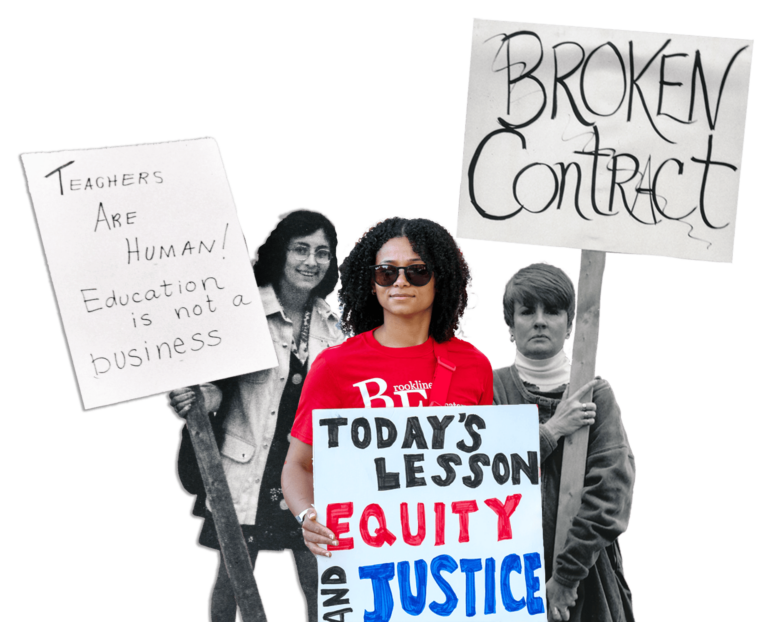
The first concerted work stoppages occurred after municipal employees in Massachusetts won the right to bargaining collectively in 1965. Striking was illegal under that law and continues to be today. Work stoppages in the early years were handled by the courts and led to fines and even jail time for striking teachers.
The collective bargaining law was modified in 1973 with passage of Chapter 150E. This law extended bargaining rights to state employees, leading MTA to greatly increase its representation of public higher education faculty and staff. Ch. 150E included this definition of an unlawful work stoppage in Section 9(a): “No public employee or employee organization shall engage in a strike, and no public employee or employee organization shall induce, encourage or condone any strike, work stoppage, slowdown or withholding of services by such public employees.”
Under this law, employers who believe an educator strike is underway request a strike investigation by the Department of Labor Relations (DLR). If the DLR deems that activity to be an unlawful work stoppage, a cease and desist order is issued. Violating that order typically leads to sanctions, most often escalating fines. (The last time teachers were jailed for striking in Massachusetts was in 1980.)
A two-day strike by Watertown teachers in May of 1969 was likely the first by an MTA local to impact student instructional days. Strike activity ratcheted up four months later, when New Bedford Educators Association members walked off the job for nine days.
Interpretations of 9(a) have evolved over time. There is no bright-line distinction between a strike that shuts down a school for an entire day and a partial work stoppage, such as teachers leaving a required after-school meeting early en masse, or refusing to do certain activities that are customarily performed by educators in that local even if they aren’t required in the members’ most recent contract.
We include in this timeline any work stoppages that resulted in a finding that 9(a) had been violated by the local association as well as work stoppages that took place before 150E was enacted. However, even after 105E took effect, there are some work stoppages for which there was no 9(a) finding, including several one- and two-day strikes that were settled before a strike investigation was completed, and a four-day strike in Grafton in 1980 for which no strike investigation report can be found. Thus, we also include in this timeline actions that the local and MTA considered a strike, even if there was no finding by the state.
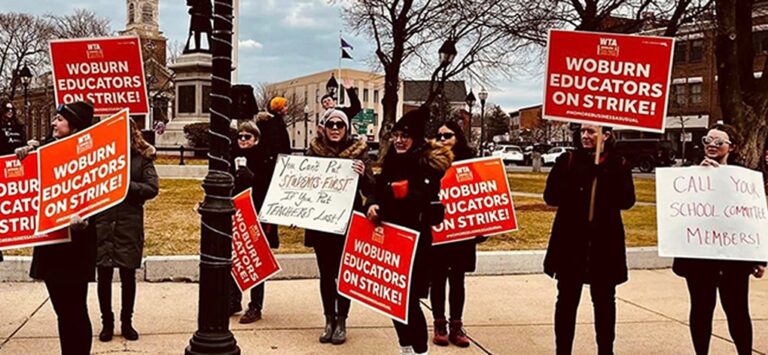
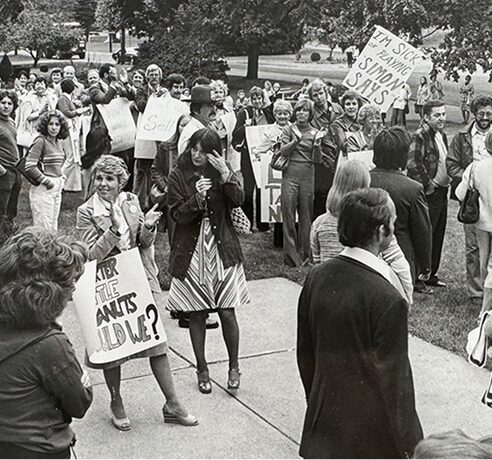
This timeline is limited to strikes by MTA locals and does not include those affiliated with AFT Massachusetts, the union that represents educators in Boston, Lawrence, Lowell, Peabody, Salem and other urban districts where educators have gone on strike. AFT Massachusetts affiliates have had some notable strikes. The Lawrence Teachers Union reports that its members went on strike in 1966, shortly after the collective bargaining law for municipal employees went into effect. That makes it the first teachers’ strike in the state. Boston Teachers Union members have been on strike three times. The first and longest was from May 1-19, 1970. BTU President John Reilly was jailed for 19 days for that strike. (Reilly later became a long-time field representative for the MTA.) The last strike by an AFT affiliate was in Salem in 1994, when the members walked out on — you guessed it — Halloween.
MTA locals also became more militant starting in the late 1960s. A two-day strike by Watertown teachers in May of 1969 was likely the first by an MTA local to impact student instructional days. Strike activity ratcheted up four months later, when New Bedford Educators Association members walked off the job for nine days. The NBEA strike garnered significant media attention and acknowledgement in MTA publications that it was indeed a strike, not just a one- or two-day “professional day” action, which is how the MTA had described the Watertown walk-out and four other work stoppages that occurred before the NBEA strike.
As we learn more about past strikes, as well as those that may occur in the future, we will update both the fact sheets and the timeline itself.
Photographs used in the timeline were taken by MTA staff members unless otherwise credited.
Articles differ in how they refer to the length of a strike, some referencing calendar days and others work days. We refer to work days in our timeline since those are the only days an employee is actually on strike, though bargaining, picketing and other strike-related activity often occur on non-work days.
We would like to acknowledge the following for making this project possible. MTA President Max Page, MTA Vice President Deb McCarthy, Executive Director-Treasurer Mike Fadel, Communications Director Amanda Torres-Price and other members of MTA’s Public Relations & Organizing Committee; Laura Barrett, MTA History Project manager; Penelope Taylor, project assistant; retired MTA staff members Alice Paes, Tedi Winkler, Steve Day and Jean Conley; Lan Kantany of the Massachusetts Department of Labor Relations; members of MTA’s Communications, Legal and Field & Organizing Divisions; and timeline designers Jennifer Fox, Laura Birek and Jessica Summa Russo.